Multi-Regional Input-Output Analysis
September 02, 2026
Source:vignettes/multiregional_analysis.Rmd
multiregional_analysis.RmdIntroduction
Multi-Regional Input-Output (MRIO) analysis extends traditional
input-output analysis to capture economic interdependencies between
multiple regions or countries. The miom class in the
fio package implements the methodology described in Miller
& Blair (2009) for analyzing multi-regional economic systems.
This vignette demonstrates how to:
- Create and work with multi-regional input-output matrices
- Compute multi-regional multipliers
- Analyze inter-regional spillover effects
- Extract country-specific input-output tables
- Measure regional interdependence
In a multi-regional system with regions and sectors per region, the total dimensions of the system are . The intermediate transactions matrix is partitioned as:
where represents intermediate flows from region to region .
Computations of the multi-regional Leontief inverse is the same from the single-region case:
where
is the multi-regional technical coefficients matrix. Therefore, the
multi-regional input-output class miom is able to inherit
methods from the iom class, implementing the additional
functionality needed for multi-regional analysis.
SHOWCASING THE miom CLASS: 2000 WORLD ECONOMY
EXAMPLE
The fiodata package includes the world_2000
dataset, which contains real multi-regional input-output data for 26
countries and 23 sectors from the year 2000. This dataset was created
using element-by-element imports from Excel files with
import_element() as demonstrated in the World
2000 script.
Let’s load and examine this real-world dataset:
# import real-world dataset
world_2000 <- fiodata::world_2000

# Examine the structure
world_2000$n_countries
#> [1] 26
world_2000$n_sectors
#> [1] 23
nrow(world_2000$intermediate_transactions)
#> [1] 598
ncol(world_2000$intermediate_transactions)
#> [1] 598

# Show the countries and sectors
world_2000$countries
#>  [1] "AUS" "AUT" "BEL" "BRA" "CAN" "CHN" "DEU" "DNK" "ESP" "FIN" "FRA" "GBR"
#> [13] "GRC" "HKG" "IND" "IRL" "ITA" "JPN" "KOR" "MEX" "NDL" "PRT" "SWE" "TWN"
#> [25] "USA" "ROW"
world_2000$sectors
#>  [1] "Agriculture, Hunting, Forestry and Fishing"
#>  [2] "Mining and Quarrying"
#>  [3] "Food, Beverages and Tobacco"
#>  [4] "Textiles, leather and footwear"
#>  [5] "Pulp, paper, printing and publishing"
#>  [6] "Coke, refined petroleum and nuclear fuel"
#>  [7] "Chemicals and chemicals products"
#>  [8] "Rubber and plastics"
#>  [9] "Other non-metallic mineral"
#> [10] "Basic metals and fabricated metal"
#> [11] "Machinery"
#> [12] "Electrical and optical equipment"
#> [13] "Transport equipment"
#> [14] "Manufacturing, recycling"
#> [15] "Electricity, gas and water supply"
#> [16] "Construction"
#> [17] "Wholesale and retail trade"
#> [18] "Hotels and restaurants"
#> [19] "Transport and storage"
#> [20] "Post and telecommunications"
#> [21] "Financial intermediation"
#> [22] "Real state, renting and business activities"
#> [23] "Community, social and personal services"
# Show a small subset of transactions (first 6 countries x sectors)
knitr::kable(
  world_2000$intermediate_transactions[1:6, 1:6],
  digits = 0,
  caption = "Sample of Intermediate Transactions (millions of dollars)"
)| AUS_Agriculture, Hunting, Forestry and Fishing | AUS_Mining and Quarrying | AUS_Food, Beverages and Tobacco | AUS_Textiles, leather and footwear | AUS_Pulp, paper, printing and publishing | AUS_Coke, refined petroleum and nuclear fuel | |
|---|---|---|---|---|---|---|
| AUS_Agriculture, Hunting, Forestry and Fishing | 2976 | 16 | 8128 | 538 | 163 | 0 |
| AUS_Mining and Quarrying | 17 | 1881 | 117 | 11 | 34 | 3355 |
| AUS_Food, Beverages and Tobacco | 796 | 33 | 3387 | 68 | 21 | 14 |
| AUS_Textiles, leather and footwear | 25 | 15 | 54 | 565 | 29 | 6 |
| AUS_Pulp, paper, printing and publishing | 92 | 75 | 834 | 56 | 2193 | 15 |
| AUS_Coke, refined petroleum and nuclear fuel | 359 | 452 | 61 | 6 | 41 | 331 |
# Show total production for first few country-sectors
knitr::kable(
  t(world_2000$total_production[1, 1:6]),
  digits = 0,
  caption = "Sample of Total Production (millions of dollars)"
)| AUS_Agriculture, Hunting, Forestry and Fishing | AUS_Mining and Quarrying | AUS_Food, Beverages and Tobacco | AUS_Textiles, leather and footwear | AUS_Pulp, paper, printing and publishing | AUS_Coke, refined petroleum and nuclear fuel |
|---|---|---|---|---|---|
| 28170 | 35785 | 35716 | 5857 | 15198 | 9871 |
The intermediate transactions matrix shows the flows of goods and services between all country-sector combinations in the global economy. The values represent monetary flows in millions of dollars. Each element represents purchases of intermediate inputs from the supplying country-sector (columns) by the purchasing country-sector (rows). It captures the complete structure of intermediate transactions between 26 countries across 23 economic sectors, providing a comprehensive view of global economic interdependencies in the year 2000.
Multi-Regional Multiplier Analysis
The miom class computes several types of multipliers
following Miller & Blair (2009):
- Intra-regional multipliers: Effects within the same region
- Spillover multipliers: Effects on other regions
- Total multipliers: Sum of intra-regional and spillover effects
world_2000$compute_multiregional_multipliers()

# Show first 10 rows of multipliers for readability
knitr::kable(
  world_2000$multiregional_multipliers[1:10, 1:10],
  digits = 4,
  caption = "Multi-Regional Multipliers (first 10 country-sectors)"
)| shock_country | shock_sector | shock_label | intra_regional_multiplier | spillover_multiplier | total_multiplier | multiplier_to_AUS | multiplier_to_AUT | multiplier_to_BEL | multiplier_to_BRA |
|---|---|---|---|---|---|---|---|---|---|
| AUS | Agriculture, Hunting, Forestry and Fishing | AUS_Agriculture, Hunting, Forestry and Fishing | 1.8179 | 0.2331 | 2.0510 | 1.8179 | 0.0012 | 0.0031 | 0.0019 |
| AUS | Mining and Quarrying | AUS_Mining and Quarrying | 1.6935 | 0.2127 | 1.9061 | 1.6935 | 0.0011 | 0.0020 | 0.0012 |
| AUS | Food, Beverages and Tobacco | AUS_Food, Beverages and Tobacco | 2.3286 | 0.2703 | 2.5990 | 2.3286 | 0.0015 | 0.0030 | 0.0027 |
| AUS | Textiles, leather and footwear | AUS_Textiles, leather and footwear | 2.0626 | 0.4556 | 2.5181 | 2.0626 | 0.0025 | 0.0056 | 0.0029 |
| AUS | Pulp, paper, printing and publishing | AUS_Pulp, paper, printing and publishing | 2.0275 | 0.3072 | 2.3347 | 2.0275 | 0.0022 | 0.0039 | 0.0024 |
| AUS | Coke, refined petroleum and nuclear fuel | AUS_Coke, refined petroleum and nuclear fuel | 2.2922 | 0.4806 | 2.7728 | 2.2922 | 0.0018 | 0.0036 | 0.0021 |
| AUS | Chemicals and chemicals products | AUS_Chemicals and chemicals products | 2.1035 | 0.5020 | 2.6055 | 2.1035 | 0.0024 | 0.0079 | 0.0035 |
| AUS | Rubber and plastics | AUS_Rubber and plastics | 1.9421 | 0.4697 | 2.4118 | 1.9421 | 0.0023 | 0.0074 | 0.0031 |
| AUS | Other non-metallic mineral | AUS_Other non-metallic mineral | 2.0107 | 0.3092 | 2.3199 | 2.0107 | 0.0017 | 0.0031 | 0.0022 |
| AUS | Basic metals and fabricated metal | AUS_Basic metals and fabricated metal | 2.0796 | 0.3984 | 2.4779 | 2.0796 | 0.0022 | 0.0034 | 0.0023 |
Interpreting the Multipliers
The multipliers table shows several key measures for each
country-sector combination (each row is a $1 final-demand shock in
shock_country / shock_sector):
- Intra-regional multiplier: The total effect within the same country when that sector receives a $1 shock
-
Spillover multiplier: The total effect on all other
countries from the same shock
- Total multiplier: The sum of intra-regional and spillover effects
- Multiplier to [Country]: The specific spillover effect on each individual country
Let’s find an interesting example. Take a look at Brazil Agriculture and it’s effects on USA:
# Find Brazil agriculture row
bra_agr_index <- which(grepl("BRA.*Agriculture", world_2000$multiregional_multipliers$shock_label))[1]
bra_agr <- world_2000$multiregional_multipliers[bra_agr_index, ]

# Show key multiplier components
multiplier_cols <- c("shock_label", "intra_regional_multiplier", "spillover_multiplier", "total_multiplier", "multiplier_to_USA")
available_cols <- intersect(multiplier_cols, names(bra_agr))
knitr::kable(bra_agr[, available_cols],
  digits = 4,
  caption = "Example: Brazil Agriculture Multipliers"
)| shock_label | intra_regional_multiplier | spillover_multiplier | total_multiplier | multiplier_to_USA | |
|---|---|---|---|---|---|
| 70 | BRA_Agriculture, Hunting, Forestry and Fishing | 1.6809 | 0.1691 | 1.85 | 0.0385 |
The multipliers reveal important insights about global economic linkages. The intra-regional multiplier shows the domestic effect within a country when one of its sectors receives a demand shock, while the spillover multiplier captures the total impact on all other countries.
Spillover Matrix
The spillover matrix provides a comprehensive view of how shocks in each country-sector affect all other country-sectors in the system:
spillover_matrix <- world_2000$get_spillover_matrix()This matrix contains the complete set of multiplier effects. For example, we can examine how a shock to the US electrical sector affects manufacturing in other countries:
# Effects of a shock to US Electrical sector
electrical_effects <- spillover_matrix[grepl("Manufacturing", rownames(spillover_matrix)), "USA_Electrical and optical equipment"]
knitr::kable(
  electrical_effects,
  digits = 10,
  caption = "Effects of a unit shock to US Electrical sector"
)| x | |
|---|---|
| AUS_Manufacturing, recycling | 0.0000278285 |
| AUT_Manufacturing, recycling | 0.0000317729 |
| BEL_Manufacturing, recycling | 0.0000746418 |
| BRA_Manufacturing, recycling | 0.0000750513 |
| CAN_Manufacturing, recycling | 0.0010488480 |
| CHN_Manufacturing, recycling | 0.0005086378 |
| DEU_Manufacturing, recycling | 0.0001300296 |
| DNK_Manufacturing, recycling | 0.0000092364 |
| ESP_Manufacturing, recycling | 0.0000666478 |
| FIN_Manufacturing, recycling | 0.0000274000 |
| FRA_Manufacturing, recycling | 0.0001874089 |
| GBR_Manufacturing, recycling | 0.0001376910 |
| GRC_Manufacturing, recycling | 0.0000050262 |
| HKG_Manufacturing, recycling | 0.0000204918 |
| IND_Manufacturing, recycling | 0.0001132960 |
| IRL_Manufacturing, recycling | 0.0000133946 |
| ITA_Manufacturing, recycling | 0.0001741727 |
| JPN_Manufacturing, recycling | 0.0002515836 |
| KOR_Manufacturing, recycling | 0.0000513328 |
| MEX_Manufacturing, recycling | 0.0003234464 |
| NDL_Manufacturing, recycling | 0.0000272870 |
| PRT_Manufacturing, recycling | 0.0000232974 |
| SWE_Manufacturing, recycling | 0.0000563693 |
| TWN_Manufacturing, recycling | 0.0001025605 |
| USA_Manufacturing, recycling | 0.0000000000 |
| ROW_Manufacturing, recycling | 0.0009231601 |
These values show the output response in each foreign country-sector to a unit shock in USA Electrical and optical equipment.
Net Spillover Effects
Net spillover effects reveal asymmetric cross-regional multiplier linkages. For countries and , (block sums from the spillover matrix).
net_spillover <- world_2000$get_net_spillover_matrix()
knitr::kable(net_spillover, digits = 4, caption = "Net Spillover Effects Matrix")| AUS | AUT | BEL | BRA | CAN | CHN | DEU | DNK | ESP | FIN | FRA | GBR | GRC | HKG | IND | IRL | ITA | JPN | KOR | MEX | NDL | PRT | SWE | TWN | USA | ROW | |
|---|---|---|---|---|---|---|---|---|---|---|---|---|---|---|---|---|---|---|---|---|---|---|---|---|---|---|
| AUS | 0.0000 | -0.0128 | 0.0161 | 0.0185 | -0.0666 | -0.2094 | -0.3254 | 0.0054 | -0.0169 | 0.1028 | -0.1678 | -0.3081 | 0.0373 | 0.2802 | 0.1332 | 0.0170 | -0.1683 | -0.4861 | 0.2846 | -0.0004 | 0.0029 | 0.0107 | -0.0414 | 0.6035 | -1.4584 | -1.6443 |
| AUT | 0.0128 | 0.0000 | -0.1123 | -0.0255 | -0.0542 | -0.1683 | -3.4544 | 0.0801 | -0.1197 | 0.0000 | -0.5047 | -0.3707 | 0.1085 | 0.0251 | -0.0127 | 0.0583 | -0.7356 | -0.3207 | -0.0394 | -0.0077 | -0.2614 | 0.0610 | -0.0481 | -0.0705 | -0.8216 | -2.0690 |
| BEL | -0.0161 | 0.1123 | 0.0000 | -0.1303 | -0.1564 | -0.2612 | -2.1978 | 0.3258 | -0.1575 | 0.0651 | -1.5795 | -1.3692 | 0.2773 | 0.1062 | 0.0709 | 0.0739 | -0.4425 | -0.5333 | -0.0801 | -0.0204 | -1.2560 | 0.2428 | -0.0370 | 0.0316 | -1.7541 | -2.2477 |
| BRA | -0.0185 | 0.0255 | 0.1303 | 0.0000 | -0.0638 | -0.1074 | -0.3114 | 0.0543 | -0.0272 | 0.0703 | -0.1351 | -0.1205 | 0.0703 | 0.1400 | -0.0121 | 0.0602 | -0.1189 | -0.3053 | -0.0575 | 0.0248 | 0.1271 | 0.1395 | -0.0003 | -0.0139 | -1.1401 | -1.3336 |
| CAN | 0.0666 | 0.0542 | 0.1564 | 0.0638 | 0.0000 | -0.1215 | -0.1589 | 0.0738 | -0.0062 | 0.0598 | -0.0793 | -0.3592 | 0.0755 | 0.4725 | 0.0422 | 0.2618 | -0.0790 | -0.3763 | 0.0299 | 0.0400 | 0.0914 | 0.0575 | 0.0410 | -0.0074 | -4.7295 | -0.9500 |
| CHN | 0.2094 | 0.1683 | 0.2612 | 0.1074 | 0.1215 | 0.0000 | -0.0647 | 0.2008 | 0.1432 | 0.1481 | 0.0488 | 0.0196 | 0.1972 | 3.2840 | 0.1929 | 0.2366 | 0.0578 | -0.9235 | 0.0400 | 0.1713 | 0.2811 | 0.1269 | 0.0763 | -0.1745 | -0.4623 | -1.0555 |
| DEU | 0.3254 | 3.4544 | 2.1978 | 0.3114 | 0.1589 | 0.0647 | 0.0000 | 2.0943 | 0.9054 | 1.1904 | 0.4801 | 0.1591 | 1.2163 | 0.6132 | 0.2229 | 0.9037 | 0.4094 | -0.2973 | 0.1949 | 0.2775 | 1.4774 | 1.4083 | 1.6150 | 0.8653 | -0.7504 | -1.2917 |
| DNK | -0.0054 | -0.0801 | -0.3258 | -0.0543 | -0.0738 | -0.2008 | -2.0943 | 0.0000 | -0.1529 | -0.0126 | -0.6395 | -1.0682 | 0.0649 | 0.0549 | -0.0269 | 0.0893 | -0.5411 | -0.2305 | -0.0836 | -0.0077 | -0.5998 | 0.0259 | -0.8529 | -0.0162 | -0.7998 | -1.9055 |
| ESP | 0.0169 | 0.1197 | 0.1575 | 0.0272 | 0.0062 | -0.1432 | -0.9054 | 0.1529 | 0.0000 | 0.0762 | -0.8883 | -0.4055 | 0.3551 | 0.1613 | -0.0049 | 0.2886 | -0.6444 | -0.2458 | -0.0200 | -0.0514 | 0.0455 | 2.4591 | 0.0988 | 0.1080 | -0.5864 | -1.8137 |
| FIN | -0.1028 | 0.0000 | -0.0651 | -0.0703 | -0.0598 | -0.1481 | -1.1904 | 0.0126 | -0.0762 | 0.0000 | -0.4082 | -0.5926 | 0.1242 | 0.0389 | -0.0104 | 0.0738 | -0.3406 | -0.4668 | -0.0713 | -0.0079 | -0.2015 | 0.0461 | -0.3288 | -0.0692 | -0.9072 | -2.3061 |
| FRA | 0.1678 | 0.5047 | 1.5795 | 0.1351 | 0.0793 | -0.0488 | -0.4801 | 0.6395 | 0.8883 | 0.4082 | 0.0000 | -0.1323 | 0.7620 | 0.4191 | 0.1152 | 0.8238 | 0.0105 | -0.2843 | 0.1093 | 0.0987 | 0.6057 | 1.0754 | 0.7666 | 0.1600 | -0.8321 | -1.2457 |
| GBR | 0.3081 | 0.3707 | 1.3692 | 0.1205 | 0.3592 | -0.0196 | -0.1591 | 1.0682 | 0.4055 | 0.5926 | 0.1323 | 0.0000 | 0.5151 | 0.5883 | 0.3410 | 4.1994 | 0.0674 | -0.3685 | 0.0660 | 0.0746 | 1.0018 | 0.7635 | 1.0191 | 0.5895 | -1.0395 | -1.1629 |
| GRC | -0.0373 | -0.1085 | -0.2773 | -0.0703 | -0.0755 | -0.1972 | -1.2163 | -0.0649 | -0.3551 | -0.1242 | -0.7620 | -0.5151 | 0.0000 | -0.0519 | -0.0550 | -0.0608 | -1.6529 | -0.2026 | -0.1080 | -0.0129 | -0.4536 | -0.0221 | -0.2269 | -0.0965 | -0.5765 | -3.1367 |
| HKG | -0.2802 | -0.0251 | -0.1062 | -0.1400 | -0.4725 | -3.2840 | -0.6132 | -0.0549 | -0.1613 | -0.0389 | -0.4191 | -0.5883 | 0.0519 | 0.0000 | 0.0359 | 0.1734 | -0.6494 | -2.3815 | -1.3598 | -0.0428 | -0.3130 | 0.0171 | -0.0231 | -0.4679 | -3.2704 | -6.2372 |
| IND | -0.1332 | 0.0127 | -0.0709 | 0.0121 | -0.0422 | -0.1929 | -0.2229 | 0.0269 | 0.0049 | 0.0104 | -0.1152 | -0.3410 | 0.0550 | -0.0359 | 0.0000 | 0.0811 | -0.0916 | -0.3318 | -0.0870 | 0.0157 | -0.0116 | 0.0606 | -0.0037 | -0.0025 | -0.5878 | -2.9286 |
| IRL | -0.0170 | -0.0583 | -0.0739 | -0.0602 | -0.2618 | -0.2366 | -0.9037 | -0.0893 | -0.2886 | -0.0738 | -0.8238 | -4.1994 | 0.0608 | -0.1734 | -0.0811 | 0.0000 | -0.5089 | -0.6792 | -0.2360 | -0.0227 | -0.3643 | 0.0139 | -0.1881 | -0.1746 | -3.0383 | -2.1441 |
| ITA | 0.1683 | 0.7356 | 0.4425 | 0.1189 | 0.0790 | -0.0578 | -0.4094 | 0.5411 | 0.6444 | 0.3406 | -0.0105 | -0.0674 | 1.6529 | 0.6494 | 0.0916 | 0.5089 | 0.0000 | -0.1670 | 0.0946 | 0.1297 | 0.1910 | 0.7478 | 0.3421 | 0.1276 | -0.4831 | -1.6802 |
| JPN | 0.4861 | 0.3207 | 0.5333 | 0.3053 | 0.3763 | 0.9235 | 0.2973 | 0.2305 | 0.2458 | 0.4668 | 0.2843 | 0.3685 | 0.2026 | 2.3815 | 0.3318 | 0.6792 | 0.1670 | 0.0000 | 1.5110 | 0.4463 | 0.5557 | 0.3128 | 0.3421 | 1.7225 | -0.0264 | -0.4335 |
| KOR | -0.2846 | 0.0394 | 0.0801 | 0.0575 | -0.0299 | -0.0400 | -0.1949 | 0.0836 | 0.0200 | 0.0713 | -0.1093 | -0.0660 | 0.1080 | 1.3598 | 0.0870 | 0.2360 | -0.0946 | -1.5110 | 0.0000 | 0.1797 | 0.0487 | 0.1268 | 0.0371 | 0.2292 | -1.5061 | -2.8225 |
| MEX | 0.0004 | 0.0077 | 0.0204 | -0.0248 | -0.0400 | -0.1713 | -0.2775 | 0.0077 | 0.0514 | 0.0079 | -0.0987 | -0.0746 | 0.0129 | 0.0428 | -0.0157 | 0.0227 | -0.1297 | -0.4463 | -0.1797 | 0.0000 | 0.0109 | 0.0932 | -0.0369 | -0.0638 | -4.6417 | -0.6929 |
| NDL | -0.0029 | 0.2614 | 1.2560 | -0.1271 | -0.0914 | -0.2811 | -1.4774 | 0.5998 | -0.0455 | 0.2015 | -0.6057 | -1.0018 | 0.4536 | 0.3130 | 0.0116 | 0.3643 | -0.1910 | -0.5557 | -0.0487 | -0.0109 | 0.0000 | 0.3416 | 0.1307 | 0.3147 | -1.7635 | -2.9057 |
| PRT | -0.0107 | -0.0610 | -0.2428 | -0.1395 | -0.0575 | -0.1269 | -1.4083 | -0.0259 | -2.4591 | -0.0461 | -1.0754 | -0.7635 | 0.0221 | -0.0171 | -0.0606 | -0.0139 | -0.7478 | -0.3128 | -0.1268 | -0.0932 | -0.3416 | 0.0000 | -0.1161 | -0.0513 | -0.5927 | -2.1151 |
| SWE | 0.0414 | 0.0481 | 0.0370 | 0.0003 | -0.0410 | -0.0763 | -1.6150 | 0.8529 | -0.0988 | 0.3288 | -0.7666 | -1.0191 | 0.2269 | 0.0231 | 0.0037 | 0.1881 | -0.3421 | -0.3421 | -0.0371 | 0.0369 | -0.1307 | 0.1161 | 0.0000 | -0.0189 | -0.9712 | -1.8780 |
| TWN | -0.6035 | 0.0705 | -0.0316 | 0.0139 | 0.0074 | 0.1745 | -0.8653 | 0.0162 | -0.1080 | 0.0692 | -0.1600 | -0.5895 | 0.0965 | 0.4679 | 0.0025 | 0.1746 | -0.1276 | -1.7225 | -0.2292 | 0.0638 | -0.3147 | 0.0513 | 0.0189 | 0.0000 | -1.2744 | -2.5937 |
| USA | 1.4584 | 0.8216 | 1.7541 | 1.1401 | 4.7295 | 0.4623 | 0.7504 | 0.7998 | 0.5864 | 0.9072 | 0.8321 | 1.0395 | 0.5765 | 3.2704 | 0.5878 | 3.0383 | 0.4831 | 0.0264 | 1.5061 | 4.6417 | 1.7635 | 0.5927 | 0.9712 | 1.2744 | 0.0000 | 0.7676 |
| ROW | 1.6443 | 2.0690 | 2.2477 | 1.3336 | 0.9500 | 1.0555 | 1.2917 | 1.9055 | 1.8137 | 2.3061 | 1.2457 | 1.1629 | 3.1367 | 6.2372 | 2.9286 | 2.1441 | 1.6802 | 0.4335 | 2.8225 | 0.6929 | 2.9057 | 2.1151 | 1.8780 | 2.5937 | -0.7676 | 0.0000 |
The interpretation is:
-
Positive
net[r, s]: countryrreceives more cross-regional output response from shocks insthansreceives from shocks inr(row country is a net recipient relative to the column country). -
Negative
net[r, s]: the column country receives more than the row country. - Values close to zero: roughly symmetric spillover relationship.
For example, net["USA", "CHN"] > 0 means a unit
final-demand shock in China induces more output response in the USA than
a comparable shock in the USA induces in China.
Key Sectors Analysis
Key sectors analysis identifies sectors with strong backward and forward linkages in the multi-regional system:
world_2000$compute_key_sectors()

key_sectors_table <- world_2000$key_sectors[, c(
  "country", "sector_name",
  "power_dispersion", "sensitivity_dispersion", "key_sectors"
)]
knitr::kable(head(key_sectors_table), digits = 4, caption = "Key Sectors Analysis")| country | sector_name | power_dispersion | sensitivity_dispersion | key_sectors |
|---|---|---|---|---|
| AUS | Agriculture, Hunting, Forestry and Fishing | 0.9231 | 0.9372 | Non-Key Sector |
| AUS | Mining and Quarrying | 0.8579 | 1.3972 | Strong Forward Linkage |
| AUS | Food, Beverages and Tobacco | 1.1698 | 0.7489 | Strong Backward Linkage |
| AUS | Textiles, leather and footwear | 1.1334 | 0.5495 | Strong Backward Linkage |
| AUS | Pulp, paper, printing and publishing | 1.0508 | 0.7826 | Strong Backward Linkage |
| AUS | Coke, refined petroleum and nuclear fuel | 1.2480 | 0.6396 | Strong Backward Linkage |
Key sectors are defined as those with above-average values in both power dispersion (backward linkages) and sensitivity dispersion (forward linkages). If both values exceed 1, the sector is classified as a key sector.
knitr::kable(
  subset(key_sectors_table, key_sectors == "Key Sector"),
  digits = 4,
  caption = "World Key Sectors"
)| country | sector_name | power_dispersion | sensitivity_dispersion | key_sectors | |
|---|---|---|---|---|---|
| 10 | AUS | Basic metals and fabricated metal | 1.1153 | 1.1820 | Key Sector |
| 19 | AUS | Transport and storage | 1.0424 | 1.3665 | Key Sector |
| 63 | BEL | Wholesale and retail trade | 1.0474 | 2.1698 | Key Sector |
| 65 | BEL | Transport and storage | 1.1411 | 1.5131 | Key Sector |
| 76 | BRA | Chemicals and chemicals products | 1.1417 | 1.2050 | Key Sector |
| 79 | BRA | Basic metals and fabricated metal | 1.0736 | 1.1132 | Key Sector |
| 119 | CHN | Textiles, leather and footwear | 1.3286 | 1.1093 | Key Sector |
| 120 | CHN | Pulp, paper, printing and publishing | 1.2516 | 1.0303 | Key Sector |
| 122 | CHN | Chemicals and chemicals products | 1.3459 | 1.9790 | Key Sector |
| 123 | CHN | Rubber and plastics | 1.4161 | 1.0886 | Key Sector |
| 125 | CHN | Basic metals and fabricated metal | 1.4585 | 2.4764 | Key Sector |
| 126 | CHN | Machinery | 1.3794 | 1.2067 | Key Sector |
| 127 | CHN | Electrical and optical equipment | 1.4747 | 1.6025 | Key Sector |
| 129 | CHN | Manufacturing, recycling | 1.2086 | 1.0453 | Key Sector |
| 130 | CHN | Electricity, gas and water supply | 1.2553 | 1.7450 | Key Sector |
| 132 | CHN | Wholesale and retail trade | 1.0484 | 2.1414 | Key Sector |
| 134 | CHN | Transport and storage | 1.0038 | 1.5373 | Key Sector |
| 145 | DEU | Chemicals and chemicals products | 1.0474 | 2.2578 | Key Sector |
| 146 | DEU | Rubber and plastics | 1.0202 | 1.0244 | Key Sector |
| 148 | DEU | Basic metals and fabricated metal | 1.0454 | 2.4121 | Key Sector |
| 149 | DEU | Machinery | 1.0253 | 1.3351 | Key Sector |
| 150 | DEU | Electrical and optical equipment | 1.0221 | 1.6899 | Key Sector |
| 151 | DEU | Transport equipment | 1.2205 | 1.5320 | Key Sector |
| 157 | DEU | Transport and storage | 1.0201 | 1.9335 | Key Sector |
| 180 | DNK | Transport and storage | 1.1129 | 1.1100 | Key Sector |
| 191 | ESP | Chemicals and chemicals products | 1.1491 | 1.1413 | Key Sector |
| 194 | ESP | Basic metals and fabricated metal | 1.1418 | 1.6170 | Key Sector |
| 203 | ESP | Transport and storage | 1.0117 | 1.4705 | Key Sector |
| 212 | FIN | Pulp, paper, printing and publishing | 1.0648 | 1.2643 | Key Sector |
| 217 | FIN | Basic metals and fabricated metal | 1.1967 | 1.1400 | Key Sector |
| 219 | FIN | Electrical and optical equipment | 1.1325 | 1.0286 | Key Sector |
| 235 | FRA | Pulp, paper, printing and publishing | 1.0948 | 1.0433 | Key Sector |
| 237 | FRA | Chemicals and chemicals products | 1.1763 | 1.4539 | Key Sector |
| 240 | FRA | Basic metals and fabricated metal | 1.0929 | 1.6608 | Key Sector |
| 242 | FRA | Electrical and optical equipment | 1.1437 | 1.1142 | Key Sector |
| 243 | FRA | Transport equipment | 1.3170 | 1.0230 | Key Sector |
| 260 | GBR | Chemicals and chemicals products | 1.0925 | 1.4232 | Key Sector |
| 263 | GBR | Basic metals and fabricated metal | 1.0614 | 1.4967 | Key Sector |
| 265 | GBR | Electrical and optical equipment | 1.1180 | 1.1481 | Key Sector |
| 268 | GBR | Electricity, gas and water supply | 1.1078 | 1.2209 | Key Sector |
| 269 | GBR | Construction | 1.0719 | 1.0766 | Key Sector |
| 274 | GBR | Financial intermediation | 1.0443 | 1.7971 | Key Sector |
| 302 | HKG | Food, Beverages and Tobacco | 1.1664 | 1.6876 | Key Sector |
| 328 | IND | Coke, refined petroleum and nuclear fuel | 1.0923 | 1.0242 | Key Sector |
| 329 | IND | Chemicals and chemicals products | 1.2440 | 1.2686 | Key Sector |
| 332 | IND | Basic metals and fabricated metal | 1.2139 | 1.4188 | Key Sector |
| 337 | IND | Electricity, gas and water supply | 1.0560 | 1.3664 | Key Sector |
| 341 | IND | Transport and storage | 1.0298 | 1.3372 | Key Sector |
| 364 | IRL | Transport and storage | 1.1478 | 1.0157 | Key Sector |
| 372 | ITA | Textiles, leather and footwear | 1.2000 | 1.0926 | Key Sector |
| 375 | ITA | Chemicals and chemicals products | 1.2347 | 1.2772 | Key Sector |
| 378 | ITA | Basic metals and fabricated metal | 1.1569 | 1.8881 | Key Sector |
| 379 | ITA | Machinery | 1.1753 | 1.0061 | Key Sector |
| 380 | ITA | Electrical and optical equipment | 1.1478 | 1.0112 | Key Sector |
| 383 | ITA | Electricity, gas and water supply | 1.0292 | 1.0177 | Key Sector |
| 387 | ITA | Transport and storage | 1.0400 | 1.7155 | Key Sector |
| 398 | JPN | Chemicals and chemicals products | 1.0680 | 2.0598 | Key Sector |
| 399 | JPN | Rubber and plastics | 1.0769 | 1.0362 | Key Sector |
| 401 | JPN | Basic metals and fabricated metal | 1.0922 | 2.2050 | Key Sector |
| 403 | JPN | Electrical and optical equipment | 1.0510 | 1.9391 | Key Sector |
| 404 | JPN | Transport equipment | 1.2852 | 1.3949 | Key Sector |
| 419 | KOR | Pulp, paper, printing and publishing | 1.2710 | 1.0932 | Key Sector |
| 420 | KOR | Coke, refined petroleum and nuclear fuel | 1.1157 | 1.2112 | Key Sector |
| 421 | KOR | Chemicals and chemicals products | 1.3239 | 1.8206 | Key Sector |
| 424 | KOR | Basic metals and fabricated metal | 1.3695 | 1.7999 | Key Sector |
| 426 | KOR | Electrical and optical equipment | 1.2945 | 1.3842 | Key Sector |
| 433 | KOR | Transport and storage | 1.0373 | 1.1349 | Key Sector |
| 467 | NDL | Chemicals and chemicals products | 1.1497 | 1.1829 | Key Sector |
| 498 | PRT | Electricity, gas and water supply | 1.0681 | 1.1445 | Key Sector |
| 511 | SWE | Pulp, paper, printing and publishing | 1.0473 | 1.0424 | Key Sector |
| 516 | SWE | Basic metals and fabricated metal | 1.0984 | 1.1055 | Key Sector |
| 525 | SWE | Transport and storage | 1.1136 | 1.9434 | Key Sector |
| 536 | TWN | Chemicals and chemicals products | 1.2469 | 1.2143 | Key Sector |
| 539 | TWN | Basic metals and fabricated metal | 1.2025 | 1.3962 | Key Sector |
| 541 | TWN | Electrical and optical equipment | 1.2224 | 1.1953 | Key Sector |
| 553 | USA | Agriculture, Hunting, Forestry and Fishing | 1.0012 | 1.2661 | Key Sector |
| 556 | USA | Textiles, leather and footwear | 1.0948 | 1.0618 | Key Sector |
| 560 | USA | Rubber and plastics | 1.0316 | 1.0854 | Key Sector |
| 563 | USA | Machinery | 1.0216 | 1.3285 | Key Sector |
| 565 | USA | Transport equipment | 1.1251 | 1.7447 | Key Sector |
| 578 | ROW | Food, Beverages and Tobacco | 1.0529 | 1.5380 | Key Sector |
| 579 | ROW | Textiles, leather and footwear | 1.1340 | 1.1697 | Key Sector |
| 580 | ROW | Pulp, paper, printing and publishing | 1.0485 | 1.2715 | Key Sector |
| 581 | ROW | Coke, refined petroleum and nuclear fuel | 1.1331 | 2.2760 | Key Sector |
| 582 | ROW | Chemicals and chemicals products | 1.0845 | 2.6993 | Key Sector |
| 583 | ROW | Rubber and plastics | 1.1301 | 1.1152 | Key Sector |
| 584 | ROW | Other non-metallic mineral | 1.0302 | 1.0963 | Key Sector |
| 585 | ROW | Basic metals and fabricated metal | 1.1366 | 3.2848 | Key Sector |
| 587 | ROW | Electrical and optical equipment | 1.1871 | 1.6445 | Key Sector |
| 588 | ROW | Transport equipment | 1.2550 | 1.0977 | Key Sector |
| 589 | ROW | Manufacturing, recycling | 1.0453 | 1.0622 | Key Sector |
Regional Interdependence Analysis
When a region increases its final demand, it doesn’t just buy from local suppliers. It imports intermediate inputs from other regions, which in turn require inputs from their suppliers, creating a chain reaction.
Regional interdependence measures help understand cross-country
multiplier linkages. The get_regional_interdependence()
method computes several key indicators (Miller & Blair, 2009,
section 6.3.2):
- Self-reliance: Average intra-regional column multiplier by country (sector-level mean)
- Total spillover out: Block sum of foreign output induced by all unit shocks in the country
- Total spillover in: Block sum of domestic output induced by all unit shocks abroad
-
Spillover balance:
total_spillover_out - total_spillover_in(negative means net recipient of cross-region spillovers) -
Spillover export share:
total_spillover_out / (total_spillover_out + total_spillover_in)
interdependence <- world_2000$get_regional_interdependence()
knitr::kable(interdependence, digits = 4) |> head()
#> [1] "|country | self_reliance| total_spillover_out| total_spillover_in| spillover_balance| spillover_export_share|"
#> [2] "|:-------|-------------:|-------------------:|------------------:|-----------------:|----------------------:|"
#> [3] "|AUS     |        1.9685|              7.2876|             3.8940|            3.3937|                 0.6518|"
#> [4] "|AUT     |        1.6145|             11.2717|             2.4211|            8.8505|                 0.8232|"
#> [5] "|BEL     |        1.6499|             17.6001|             6.6666|           10.9334|                 0.7253|"
#> [6] "|BRA     |        1.9189|              5.3547|             2.4314|            2.9233|                 0.6877|"
Now let’s plot the results and make sense of it. China has the greater self-reliance index, meaning that, on average, shocks in that economy causes higher domestic impact.
ggplot(interdependence, aes(x = reorder(country, self_reliance), y = self_reliance)) +
  geom_bar(stat = "identity") +
  coord_flip() +
  labs(
    title = "Self-reliance index by country",
    x = "Country",
    y = "Average intra-regional multiplier"
  ) +
  theme_minimal()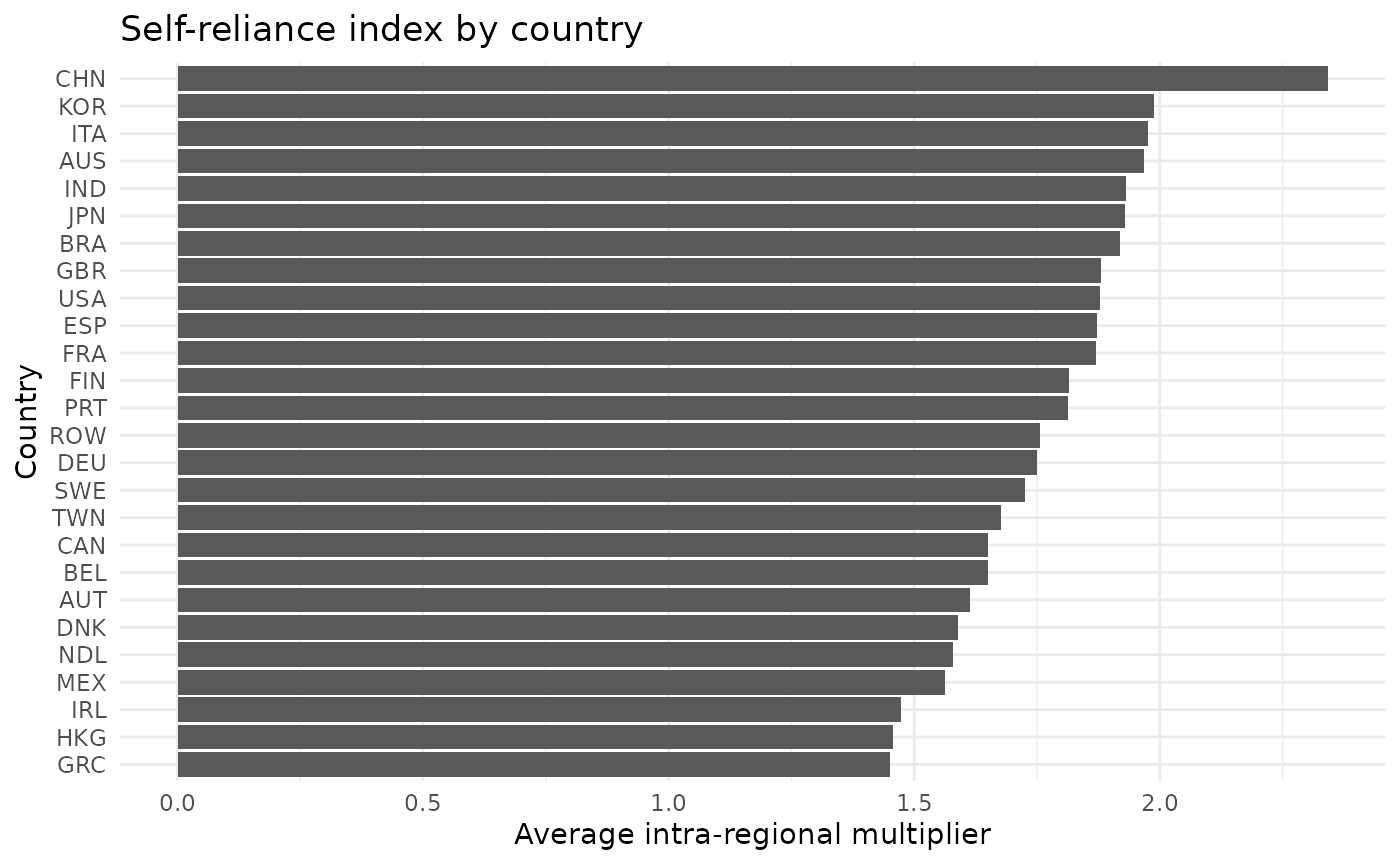
Concerning spillover to other countries, Hong Kong has the greatest value, meaning demand increases in that country triggers demand abroad. It is expected that a small city-state isn’t able to fulfill demand industry-wide, thus stimulating suppliers abroad.
ggplot(interdependence, aes(x = reorder(country, total_spillover_out), y = total_spillover_out)) +
  geom_bar(stat = "identity") +
  coord_flip() +
  labs(
    title = "Total spillover to other countries by country",
    x = "Country",
    y = "Sum of induced multipliers abroad"
  ) +
  theme_minimal()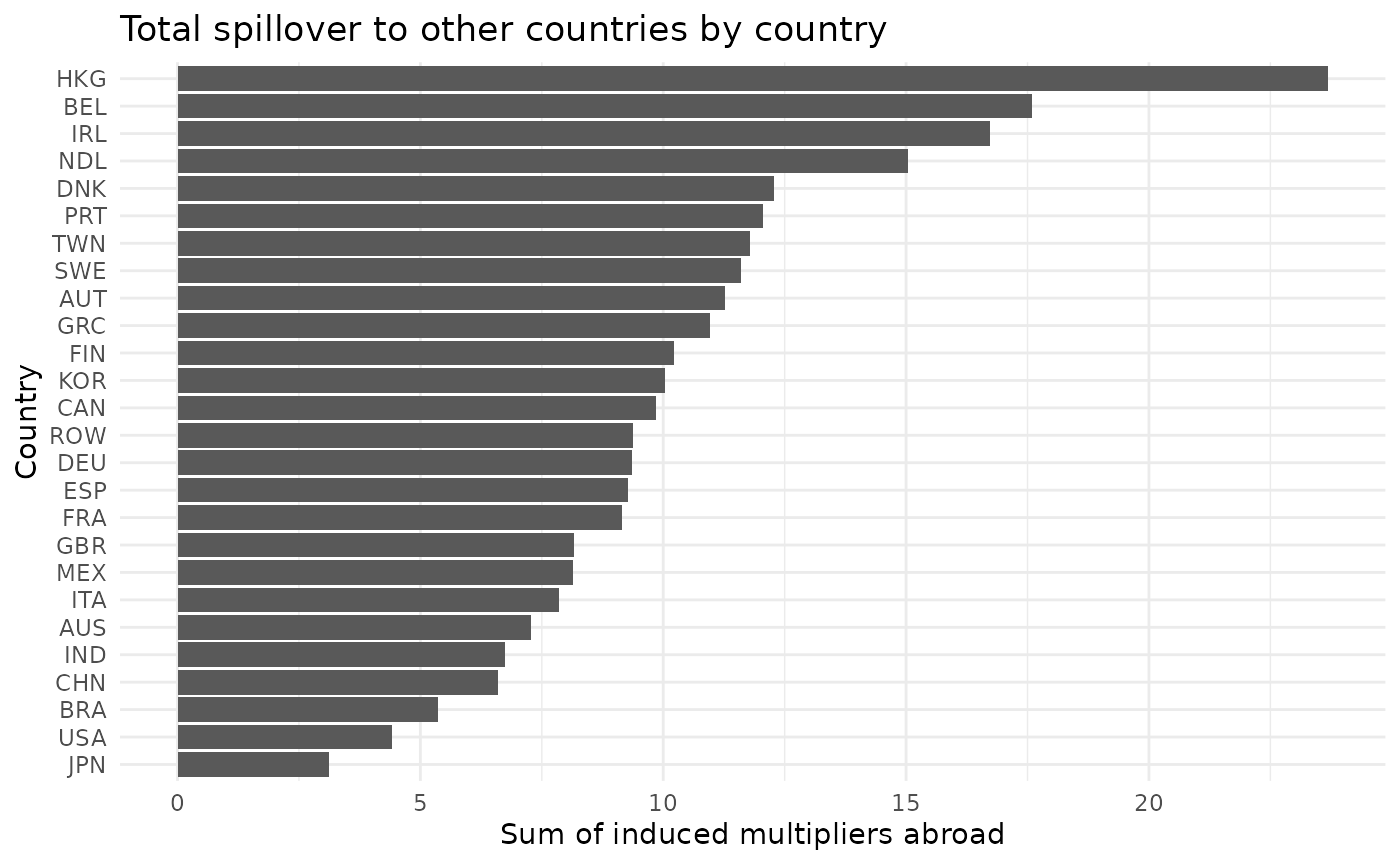
On the other hand, USA absorbs the most spillover-in effects. It means that USA benefits the most from demand shocks in other countries.
interdependence |>
  subset(!country %in% "ROW") |>
  ggplot(aes(x = reorder(country, total_spillover_in), y = total_spillover_in)) +
  geom_bar(stat = "identity") +
  coord_flip() +
  labs(
    title = "Total spillover absorbed by country",
    x = "Country",
    y = "Sum of induced multipliers at home"
  ) +
  theme_minimal()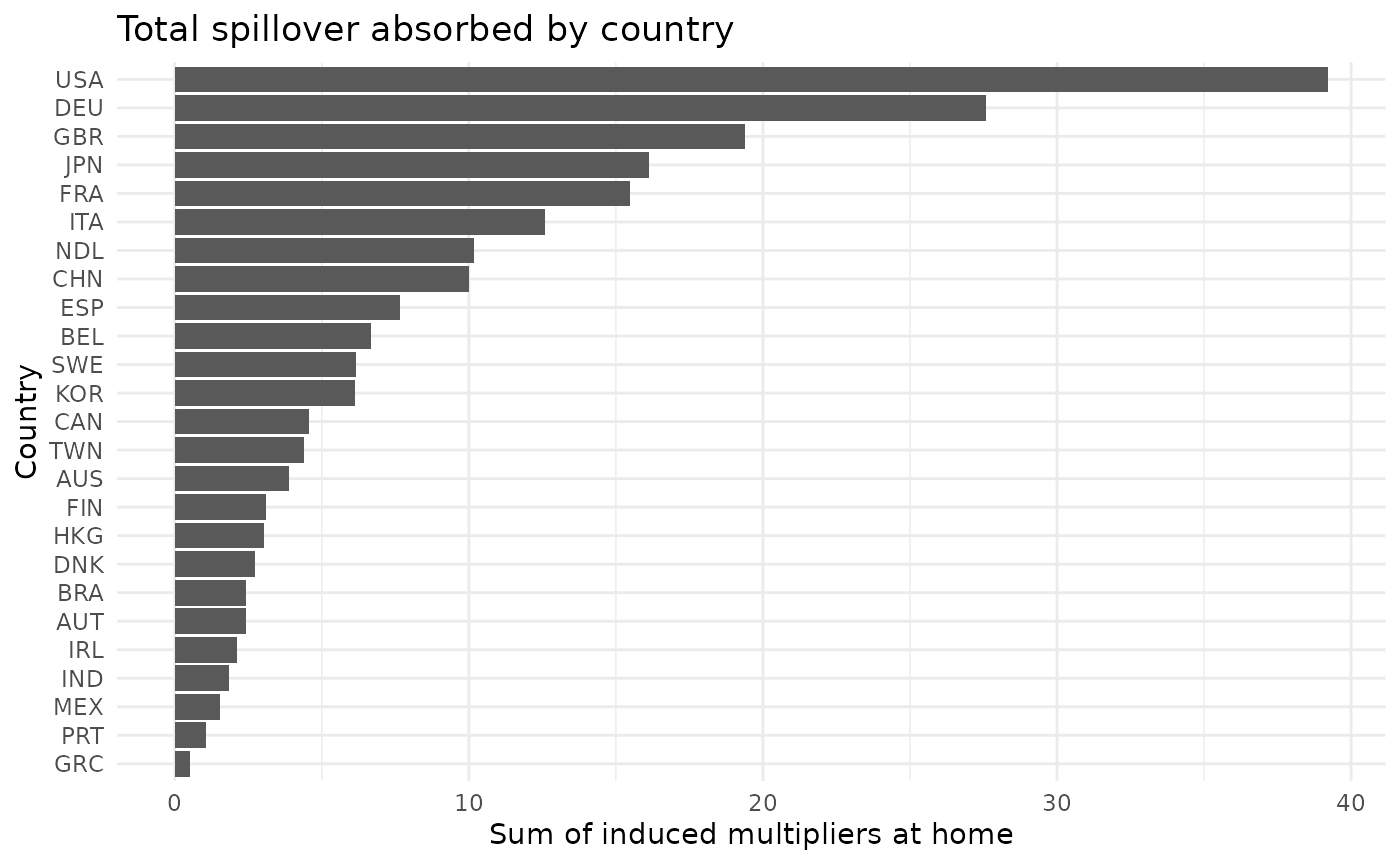
The Spillover Balance measures whether a specific region or sector is a net “giver” or a net “receiver” of economic stimulus across boundaries. It is calculated as the difference between the economic activity a region exports via spillovers and what it pulls in from others.
If balance is positive, the region is a net contributor. This means when your region spends money, it leaks a massive amount of demand out to other regions, but when they spend money, your industries don’t catch much of it.
A negative balance indicates the country is a net beneficiary, meaning your economy is highly capable of capturing the spillover effects of external spending. When other regions increase production, your local industries see a massive surge in demand for your intermediate inputs.
Results demonstrates that highly industrialized countries has negative balance, meaning they are able to absorb more spillover effects than leak it.
interdependence |>
  subset(!country %in% "ROW") |>
  ggplot(aes(x = reorder(country, spillover_balance), y = spillover_balance)) +
  geom_bar(stat = "identity") +
  coord_flip() +
  labs(
    title = "Spillover balance by country",
    x = "Country",
    y = "Spillover out - Spillover in"
  ) +
  theme_minimal()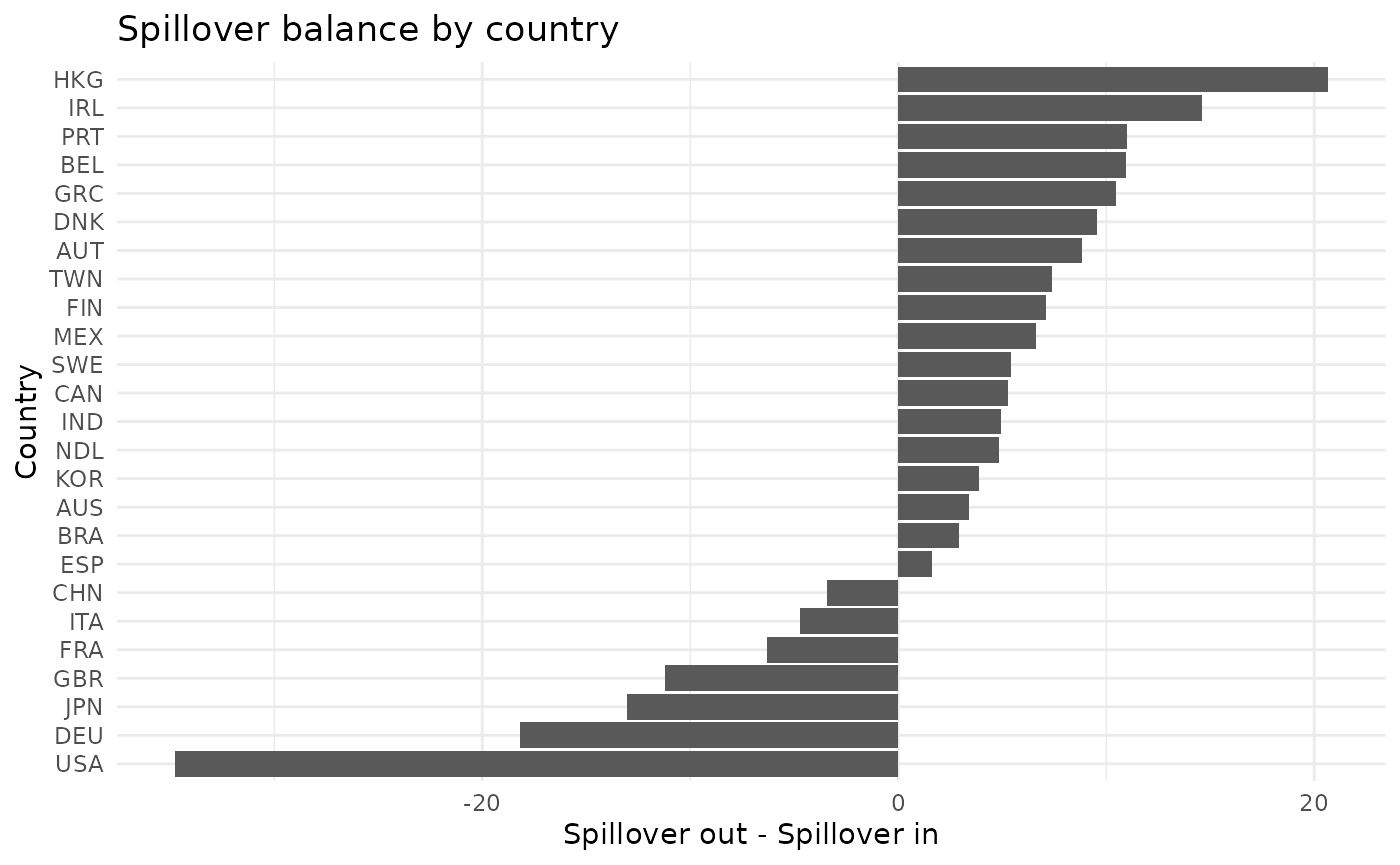
The Spillover Export Share measures the degree of external leakages relative to the total economic impact. It evaluates how much of the total economic multiplier generated by a region’s initial spending escapes to benefit foreign economies rather than staying local.
A higher share (e.g., 60%) indicates that a massive portion of the economic stimulus leaves the region. This typically happens in highly specialized, smaller, or open economies that rely heavily on importing specialized components, parts, or raw materials to complete production.
A lower share (e.g., 10%) means that the vast majority of the multiplier effect stays locked inside the domestic economy. This is characteristic of large, highly diversified economies with mature internal supply chains that can supply almost all of their own intermediate needs.
ggplot(interdependence, aes(x = reorder(country, spillover_export_share), y = spillover_export_share)) +
  geom_bar(stat = "identity") +
  coord_flip() +
  labs(
    title = "Spillover export share by country",
    x = "Country",
    y = "total_spillover_out / (out + in)"
  ) +
  theme_minimal()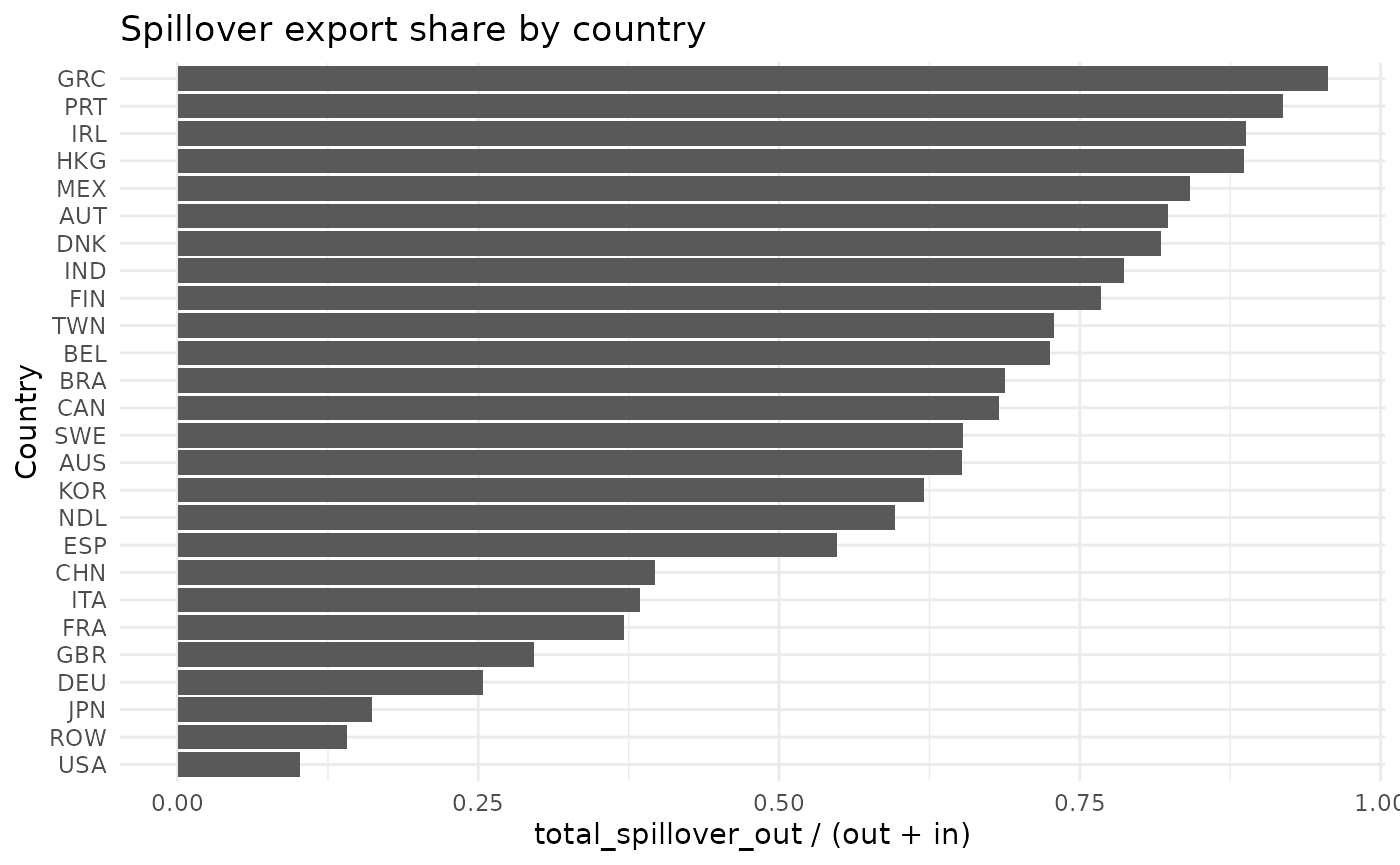
Bilateral Trade Analysis
The miom class allows extraction of bilateral trade
flows between any two countries using the
get_bilateral_trade() method:
# Get bilateral trade flows
trade_flow1 <- world_2000$get_bilateral_trade("BRA", "USA")
knitr::kable(trade_flow1[1:10, 1:5],
  digits = 2,
  caption = paste("Trade flows from", "BRA", "to", "USA", "(first 10 buying sectors, first 5 supplying sectors)")
)| BRA_Agriculture, Hunting, Forestry and Fishing | BRA_Mining and Quarrying | BRA_Food, Beverages and Tobacco | BRA_Textiles, leather and footwear | BRA_Pulp, paper, printing and publishing | |
|---|---|---|---|---|---|
| USA_Agriculture, Hunting, Forestry and Fishing | 18.23 | 0.02 | 92.85 | 1.80 | 2.80 |
| USA_Mining and Quarrying | 5.19 | 13.05 | 0.47 | 0.20 | 0.84 |
| USA_Food, Beverages and Tobacco | 8.45 | 0.06 | 29.15 | 1.99 | 0.19 |
| USA_Textiles, leather and footwear | 1.56 | 1.47 | 2.02 | 131.26 | 1.56 |
| USA_Pulp, paper, printing and publishing | 0.44 | 2.22 | 15.41 | 8.80 | 111.75 |
| USA_Coke, refined petroleum and nuclear fuel | 10.27 | 5.17 | 6.30 | 2.43 | 1.53 |
| USA_Chemicals and chemicals products | 467.80 | 31.80 | 79.89 | 138.63 | 129.08 |
| USA_Rubber and plastics | 3.79 | 3.62 | 20.65 | 5.88 | 9.43 |
| USA_Other non-metallic mineral | 0.58 | 1.00 | 2.26 | 0.21 | 0.24 |
| USA_Basic metals and fabricated metal | 2.62 | 11.05 | 13.40 | 1.16 | 4.23 |
trade_flow2 <- world_2000$get_bilateral_trade("USA", "BRA")
knitr::kable(trade_flow2[1:10, 1:5],
  digits = 2,
  caption = paste("Trade flows from", "USA", "to", "BRA", "(first 10 buying sectors, first 5 supplying sectors)")
)| USA_Agriculture, Hunting, Forestry and Fishing | USA_Mining and Quarrying | USA_Food, Beverages and Tobacco | USA_Textiles, leather and footwear | USA_Pulp, paper, printing and publishing | |
|---|---|---|---|---|---|
| BRA_Agriculture, Hunting, Forestry and Fishing | 91.70 | 0.08 | 211.27 | 4.86 | 6.39 |
| BRA_Mining and Quarrying | 1.24 | 20.45 | 0.88 | 0.15 | 1.12 |
| BRA_Food, Beverages and Tobacco | 22.36 | 0.12 | 145.10 | 2.35 | 1.80 |
| BRA_Textiles, leather and footwear | 1.94 | 0.19 | 1.02 | 111.85 | 9.46 |
| BRA_Pulp, paper, printing and publishing | 1.64 | 1.09 | 37.91 | 4.97 | 185.86 |
| BRA_Coke, refined petroleum and nuclear fuel | 36.13 | 19.79 | 8.43 | 3.78 | 15.55 |
| BRA_Chemicals and chemicals products | 44.36 | 12.97 | 18.40 | 52.28 | 48.02 |
| BRA_Rubber and plastics | 1.99 | 1.11 | 15.42 | 1.57 | 5.05 |
| BRA_Other non-metallic mineral | 0.36 | 3.31 | 12.77 | 2.27 | 1.04 |
| BRA_Basic metals and fabricated metal | 7.96 | 31.28 | 87.30 | 11.21 | 58.69 |
These matrices show the intermediate goods flows from the origin country (columns) to the destination country (rows) by sector. The values represent the monetary flows of intermediate inputs used in production.
Extracting Country-Specific Input-Output Tables
Lastly, one can obtain single-region iom objects from
the multi-regional system. The extract_country() method
allows you to extract domestic input-output tables for individual
countries from the multi-regional system:
# Extract domestic economy for deutschland in the dataset
deutsch_iom <- world_2000$extract_country("DEU")
The extracted iom object contains only the domestic
transactions for the specified country:
# Show a subset of the domestic intermediate transactions
knitr::kable(deutsch_iom$intermediate_transactions[1:8, 1:8],
  digits = 0,
  caption = paste("Deutschland Domestic Intermediate Transactions (first 8x8 sectors, millions USD)")
)| DEU_Agriculture, Hunting, Forestry and Fishing | DEU_Mining and Quarrying | DEU_Food, Beverages and Tobacco | DEU_Textiles, leather and footwear | DEU_Pulp, paper, printing and publishing | DEU_Coke, refined petroleum and nuclear fuel | DEU_Chemicals and chemicals products | DEU_Rubber and plastics | |
|---|---|---|---|---|---|---|---|---|
| DEU_Agriculture, Hunting, Forestry and Fishing | 1667 | 18 | 20853 | 247 | 285 | 10 | 158 | 160 |
| DEU_Mining and Quarrying | 37 | 68 | 52 | 9 | 42 | 1201 | 145 | 12 |
| DEU_Food, Beverages and Tobacco | 2655 | 21 | 9895 | 156 | 89 | 74 | 926 | 105 |
| DEU_Textiles, leather and footwear | 5 | 0 | 4 | 279 | 4 | 1 | 16 | 22 |
| DEU_Pulp, paper, printing and publishing | 74 | 74 | 1757 | 393 | 12433 | 117 | 1426 | 392 |
| DEU_Coke, refined petroleum and nuclear fuel | 365 | 31 | 214 | 62 | 96 | 799 | 925 | 100 |
| DEU_Chemicals and chemicals products | 806 | 68 | 544 | 871 | 847 | 292 | 6702 | 2698 |
| DEU_Rubber and plastics | 147 | 56 | 874 | 190 | 470 | 62 | 1012 | 2122 |
# Show total production
knitr::kable(t(deutsch_iom$total_production[1, 1:12]),
  digits = 0,
  caption = paste("Deutschland Total Production (first 12 sectors, millions USD)")
)| DEU_Agriculture, Hunting, Forestry and Fishing | DEU_Mining and Quarrying | DEU_Food, Beverages and Tobacco | DEU_Textiles, leather and footwear | DEU_Pulp, paper, printing and publishing | DEU_Coke, refined petroleum and nuclear fuel | DEU_Chemicals and chemicals products | DEU_Rubber and plastics | DEU_Other non-metallic mineral | DEU_Basic metals and fabricated metal | DEU_Machinery | DEU_Electrical and optical equipment |
|---|---|---|---|---|---|---|---|---|---|---|---|
| 44318 | 11871 | 117494 | 27820 | 77379 | 35496 | 110737 | 46673 | 35857 | 135138 | 142012 | 154388 |
You can then perform standard input-output analysis on the domestic economy:
deutsch_iom$compute_tech_coeff()$compute_leontief_inverse()$compute_multiplier_output()

knitr::kable(head(deutsch_iom$multiplier_output, 12),
  digits = 4,
  caption = paste("Deutschland Domestic Output Multipliers (first 12 sectors)")
)| sector | multiplier_simple | multiplier_direct | multiplier_indirect |
|---|---|---|---|
| DEU_Agriculture, Hunting, Forestry and Fishing | 1.6908 | 0.4146 | 1.2762 |
| DEU_Mining and Quarrying | 1.7559 | 0.4657 | 1.2902 |
| DEU_Food, Beverages and Tobacco | 2.0067 | 0.5981 | 1.4086 |
| DEU_Textiles, leather and footwear | 1.6419 | 0.3961 | 1.2458 |
| DEU_Pulp, paper, printing and publishing | 1.7893 | 0.4791 | 1.3102 |
| DEU_Coke, refined petroleum and nuclear fuel | 1.7602 | 0.4592 | 1.3010 |
| DEU_Chemicals and chemicals products | 1.7729 | 0.4766 | 1.2963 |
| DEU_Rubber and plastics | 1.7117 | 0.4319 | 1.2798 |
| DEU_Other non-metallic mineral | 1.7336 | 0.4434 | 1.2902 |
| DEU_Basic metals and fabricated metal | 1.7580 | 0.4514 | 1.3065 |
| DEU_Machinery | 1.7582 | 0.4518 | 1.3064 |
| DEU_Electrical and optical equipment | 1.7421 | 0.4492 | 1.2928 |
REFERENCES
Miller, Ronald E., and Peter D. Blair. Input-Output Analysis: Foundations and Extensions. 2nd ed. Cambridge University Press, 2009. https://doi.org/10.1017/CBO9780511626982.